

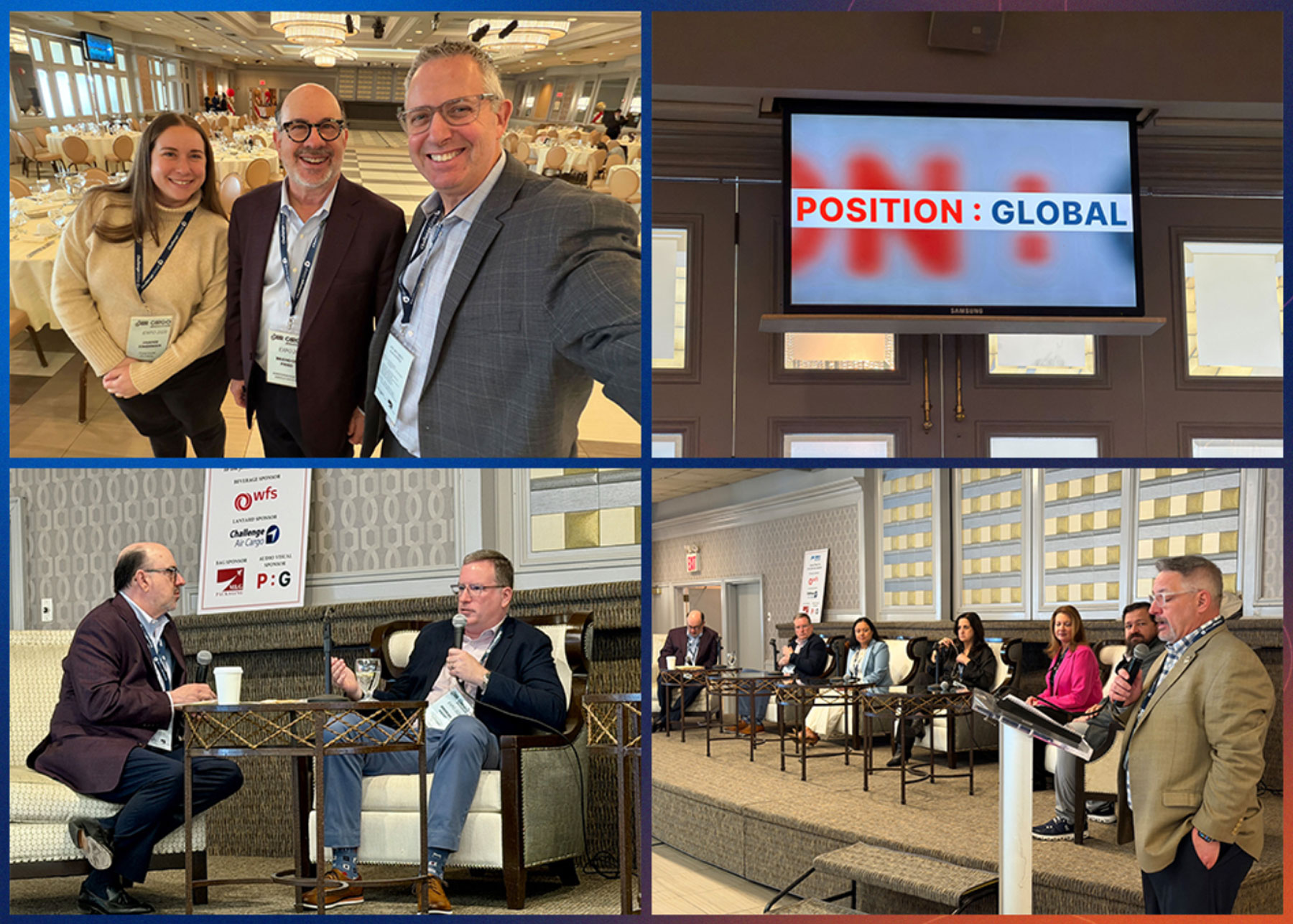
On Thursday, March 19th, I was in New York to attend the annual JFK Air Cargo Expo, hosted by Position : Global client, the JFK Air Cargo Association. This annual event draws companies and individuals from across the New York air cargo scene and combines an exhibition hall space where companies introduce their products and services to attendees, along with a Q&A panel discussion and a keynote over lunch. The event, held annually at the gorgeous Russo’s on the Bay, draws hundreds of people and is one of the highlight events on the annual calendar. It’s not unlike the LA Air Cargo Association’s annual Air Cargo Day event as well, which is coming up in May.
The event is also a chance to catch up with industry friends and spend some time together with our Director of Client Success Shanie Zimerman-Blayer who lives in the area and attended with me as well.
The opening panel was moderated by Brandon Fried, Executive Director of The Airforwarders Association, and featured the following panelists:
- Brendan Magee, Branch Manager, New York office, DACHSER USA
- Jillian Daza, District Sales Manager, Lufthansa Cargo
- Ruth Lamdan, Regional Commercial Manager Americas, Challenge Group
- Leslie Schneider-Braesnaider, National Director of Customs Brokerage and Compliance, Savino del Bene
- William McKeen, Vice President of Sales, Forward Air
Lufthansa’s “Phygital” Future — and Why the Word Matters More Than It Sounds
Jillian Daza, Lufthansa Cargo’s District Sales Manager (and the airline was fresh off being named the Airforwarders Association’s International Air Carrier of the Year in Orlando), offered what might have been the panel’s most forward-looking moment when she relayed the vision of Lufthansa Cargo CEO Ashwin Bhat. The future, Bhat has been telling his organization, is a “phygital” world — half physical, half digital.
It’s a word that could easily land with a thud in an industry that still debates whether OCR counts as innovation. But Daza framed it in a way that gave it teeth. The cost of everything has gone up, she told the room — labor, fuel, handling, compliance. Digitization isn’t an aspiration anymore; it’s a cost reduction imperative. Lufthansa needs AI and automation to handle the everyday operational load so that its people can focus where they actually create value: when chaos strikes.
What made the comment land was its honesty about what AI can and cannot do in this business. Daza was candid that Lufthansa struggles with the same information velocity that plagues the forwarders in the room — schedules change, cancellations cascade through the Middle East, and the airline sometimes has to rely on its own digital systems just to keep customers informed because the pace outstrips what a human sales team can manage in real time. The phygital framing isn’t about replacing people. It’s about acknowledging that without the digital layer handling the routine, there simply aren’t enough people to manage the exceptions — and in air cargo, the exceptions are the job.
Forward and the Force Multiplier Question
William McKeen, VP of Sales at Forward Air, brought a different angle to the AI conversation — less philosophical, more operational. Forward has been deploying technology to make its existing workforce more productive, not to shrink it.
In a consumer world where companies are leaning into using agentic AI in lieu of customer service agents with mixed success, William admitted that Forward learned that AI-driven customer service bots don’t work well in an industry where last week’s rules may not apply to this week’s shipment. “You can’t train a bot on something that came out last week,” McKeen said, which is about as clean a summary of the air cargo AI challenge as anyone offered all morning.
The phrase that recurred across multiple panelists — McKeen, Daza, Leslie Schneider-Braesnaider of Savino Del Bene — was “force multiplier.” AI replaces the data entry. It doesn’t replace the judgment. That’s the consensus position right now among operators, though whether it holds over the next three to five years as the models improve is a different question.
The Workforce Problem Nobody Has Solved
If there was a thread that wound through the entire day — panel and keynote alike — it was the industry’s deepening human capital crisis. The panel surfaced it from multiple angles, and none of them were encouraging.
Leslie Schneider-Braesnaider, Savino Del Bene’s National Director of Customs Brokerage and Compliance, identified what she called a lack of practical education. When she came up in the business, companies sent entry-level hires to the World Trade Institute, IATA classes, HAZMAT training, and FDA training courses. Most of that training infrastructure has evaporated. The supply chain management degrees that have proliferated since COVID don’t necessarily translate into knowing how to complete a customs entry or advise a client on bond sufficiency. This lack of training for new entrants flies in the face of CBP’s continuing education requirement for licensed brokers, put in place within the last several years.
Ruth Lamdan, Challenge Group’s Regional Commercial Manager for the Americas, was blunter. There’s a gap between what young professionals are educated to do and what they’re looking for in a workplace, she said — and it’s not exclusive to logistics, but logistics feels it acutely.
The panel explored the remote work question with more nuance than the topic usually gets. McKeen described Forward Air’s success with hybrid models — 35 applicants for six positions within an hour, driven largely by the hybrid offering. Daza framed it as a quality-of-people question rather than a location question: invest in the individual, measure output, and don’t pretend that a lazy employee at home would have been productive at a desk.
Pete Mento on IEEPA, Its Successors, and the Biggest Enforcement Opportunity in CBP History
Pete Mento’s luncheon keynote was, as always, part geopolitical briefing, part stand-up routine, and part fire alarm. Mento opened with the Supreme Court’s 6-3 decision striking down IEEPA tariffs and then proceeded to tick through, piece by piece, what comes next. The short version: the money’s coming back, the process will be a nightmare, and the government is building something much bigger in the background.
Mento walked the room through CAPE — Customs’ new add-on to the ACE portal — where importers will upload CSV files of entries affected by IEEPA tariffs. The mechanics sound straightforward enough: upload, validate, receive a refund upon entry liquidation, plus interest. But Mento’s warning was pointed. Between 15 and 20 percent of those entries will be audited, and the penalties for incorrect claims are brutal — 100 percent of the claim plus the claim itself. CBP is using AI to cross-reference the filings, while simultaneously telling importers they can’t use AI for their own entry work. “We trust our version of AI,” was Mento’s paraphrase of the agency’s position, delivered with the kind of deadpan that only works when the audience knows exactly how absurd the underlying reality is.
The auditing infrastructure is where Mento’s analysis turned from cautionary to alarming. CBP has built a supplier-chain database — originally constructed for forced labor and UFLPA enforcement — that maps foreign suppliers, their suppliers, and their suppliers’ suppliers. If an importer claims goods originated in Vietnam but CBP’s database shows that the Vietnamese supplier sourced the same product from China, that’s a country-of-origin problem. And it’s not a human being catching it. It’s an algorithm, running against the largest dataset of supply chain intelligence the agency has ever assembled. “CAPE is a trap,” Mento told the room. “This will be the greatest enforcement opportunity CBP has ever had.”
The math supporting that claim is sobering. Mento told the room that he has personally audited roughly 1,000 customs entries over the past 12 months and found broker errors in over 700 of them — including classification, valuation, related-party adjustments, 232 derivative calculations, and more. When CBP turns its AI-driven review process loose on IEEPA refund claims, those errors become audit triggers. Related-party transactions, anti-dumping and countervailing duty calculations, and the still-unresolved question of how to calculate 232 derivatives (two different branches of CBP have issued conflicting guidance, and the matter is currently before the Court of International Trade) all represent exposure.
And the IEEPA refunds cover only about half the affected entries — those that haven’t yet been liquidated. Entries that have already passed their 314-day liquidation window are subject to protests, with 180-day filing deadlines and aggressive review. Entries past the protest window go to the Court of International Trade, where resolution takes three to five years. Interest accrues at 6 percent. Bonds remain outstanding.
The Successor Problem
But the piece of Mento’s keynote that may matter most in the long run was his analysis of what replaces IEEPA. The administration moved immediately to Section 122 — a 10 percent across-the-board tariff on all countries for 150 days, expiring in July. Mento’s argument: Section 122’s legal foundation is shaky. The statute was designed as an emergency measure to address capital flight after Nixon took the U.S. off the gold standard. Its conditions require that money be fleeing the country. The administration’s own economic messaging claims the opposite — that hundreds of billions are flowing in. The economic conditions, Mento argued, simply don’t support the authority. Expect a legal challenge within a year.
The 232 tariffs and existing 301 tariffs against non-market economies like China are, in Mento’s assessment, largely unassailable — those statutes have survived judicial scrutiny before and will again. But the administration’s apparent plan to extend 301-style tariffs to Western Europe and allied Asian nations hits a statutory problem: the 301 mechanism was designed for non-market economies. Using it against market economies invites the same kind of legal challenge that felled IEEPA.
Mento’s conclusion was characteristically direct. This refund and enforcement cycle will persist for four to six years. It doesn’t matter who the next president is — nobody in the White House will voluntarily give up the revenue. The tariffs may change names, change statutory authorities, or change rates. They aren’t going away. “We’ve essentially created a VAT without calling it one,” he said. “There will be new names for it. There will be new ways of using it. But these tariffs are going to be your new reality.”
Pete also flagged a problem everyone in the room was acutely aware of – the insufficient number of licensed brokers to meet the moment. “Good luck finding brokers. There’s less than 10,000 of us on planet Earth right now. 50% of them are over 60. We only get 35 new brokers every test.”
As one of those 10,000 who’re closer to 60 than 23 when I passed the test back in ’94 (how the hell did that happen?), he’s not wrong.
My Final Observations
Certainly, the situation in the Middle East was a major topic of conversation because of the impact it is having on supply chains, air cargo capacity, and jet fuel prices which I didn’t even touch on. Having been in a leadership position in the air cargo association here in Chicago, the thing that I personally take away from all of these events is that we’ve all got the same problems across the industry, regardless of where we do business. At a time when people are either too busy to attend events like this, or don’t see the value behind in-person gatherings when we were scattered to our own digital ranches during the pandemic, the importance of coming together to talk, socialize, network, and find solutions to our common problems is never more important than it is now when the industry is experiencing rapid-fire changes, both from within and from without.
The 2026 JFK AirCargo Expo, themed “From Disruption to Direction,” was held March 19 at Russo’s on the Bay in Jamaica, New York, and was hosted by the JFK Air Cargo Association. The morning panel was moderated by Brandon Fried, Executive Director of the Airforwarders Association, and featured Jillian Daza (Lufthansa Cargo), Leslie Schneider-Braesnaider (Savino Del Bene), Brendan Magee (Dachser USA), Ruth Lamdan (Challenge Group), and William McKeen (Forward Air). The luncheon keynote was delivered by Pete Mento of Baker Tilly.